


Helmut Winhofer
Key Takeaways
- The Graph Integration Platform (GIP) is Austria’s nationwide intermodal reference system for public-sector transport infrastructure data. It maps road, rail, pedestrian, cycling, waterway and air traffic in a single shared digital transport graph.
- Commissioned by ÖVDAT, Evolit redeveloped the GIP 2.0 client as a web-based application. The goals: simpler workflows, better usability and a technical foundation that can be maintained for the long term.
- Built on a shared technical foundation, the new client is provided in several variants for different user groups. Individual components can be integrated directly into the existing specialist applications of the GIP partners.
Every road, every railway line, every footpath and cycle path: they are all part of a nationwide digital transport model for Austria. Waterways and air traffic are represented too. The Graph Integration Platform – GIP for short – creates a common data foundation for applications in mobility, infrastructure and public administration.
As part of GIP 2.0, this digital infrastructure has undergone comprehensive modernisation. Evolit was responsible for redeveloping the GIP 2.0 client as a web-based application – with the aim of making complex transport data easier to use, easier to integrate, more performant and maintainable in the long run.
Starting Point & Challenge: Rethinking a Proven GIS Client
As the official multimodal reference system, the GIP consolidates public-sector transport data into a single nationwide graph. The individual GIP partners maintain their data decentrally.
GIP data is available as open government data. Well-known applications such as Verkehrsauskunft Österreich (Austria’s national traffic information service) and basemap.at rely on it, and various administrative and emergency-response systems are built on GIP data as well. Numerous institutions work with the GIP, contribute different requirements and use the data in a wide range of specialist contexts. Existing workflows had to be respected, while the new solution also needed to leave room for future extensions.
The previous GIP 1.0 client had grown over many years and proven itself in operation. Its technical foundation, however, was increasingly reaching its limits in terms of usability, integration, data volumes and long-term evolution. What was needed was not just a new interface, but a fundamental modernisation of the platform.
Analysis & Approach: Sharpening Requirements Together
At the start of the project, a large number of specialist requirements had to be translated into a shared target vision. Together with ÖVDAT, Evolit structured these requirements in intensive workshops and turned them into a comprehensive requirements specification.
The most important functional and technical foundations were established in the initial phase. Open questions were explored in depth as the project progressed and fed directly back into design and implementation.
The user interface was a dedicated focus area. Prototypes in Figma, a clear information architecture, and interaction and UI design made key workflows visible and testable early on. Usability tests helped validate the requirements of different user groups and align the application with their actual working practices.
The project was delivered using an agile approach. ÖVDAT regularly received testable software versions on a dedicated environment. Specialist feedback, change requests and bug reports flowed directly into further development via tickets and ongoing coordination. Because the new GIP 2.0 server was being developed in parallel, alignment across interfaces, data models and system boundaries was a constant part of the project.
Development took place entirely within ÖVDAT’s infrastructure – covering source code, build processes, tests and documentation. This means the client organisation retains full control over the system and its future development at all times.
The software is also being released as open source under the European Union Public Licence. This raises the bar for traceable documentation, clean licensing and source code that remains understandable in the long term.
Implementation & Solution: A Modern Web Client for Austria’s Transport Data
The general GIP 2.0 client (AGC) and the measures assistant are built on a shared technical foundation. Recurring functions and components therefore do not have to be developed and maintained in parallel across two separate applications.
The shared foundation does more than simplify technical evolution. It also ensures that core interaction concepts, security mechanisms and visualisation logic are implemented consistently across both applications.
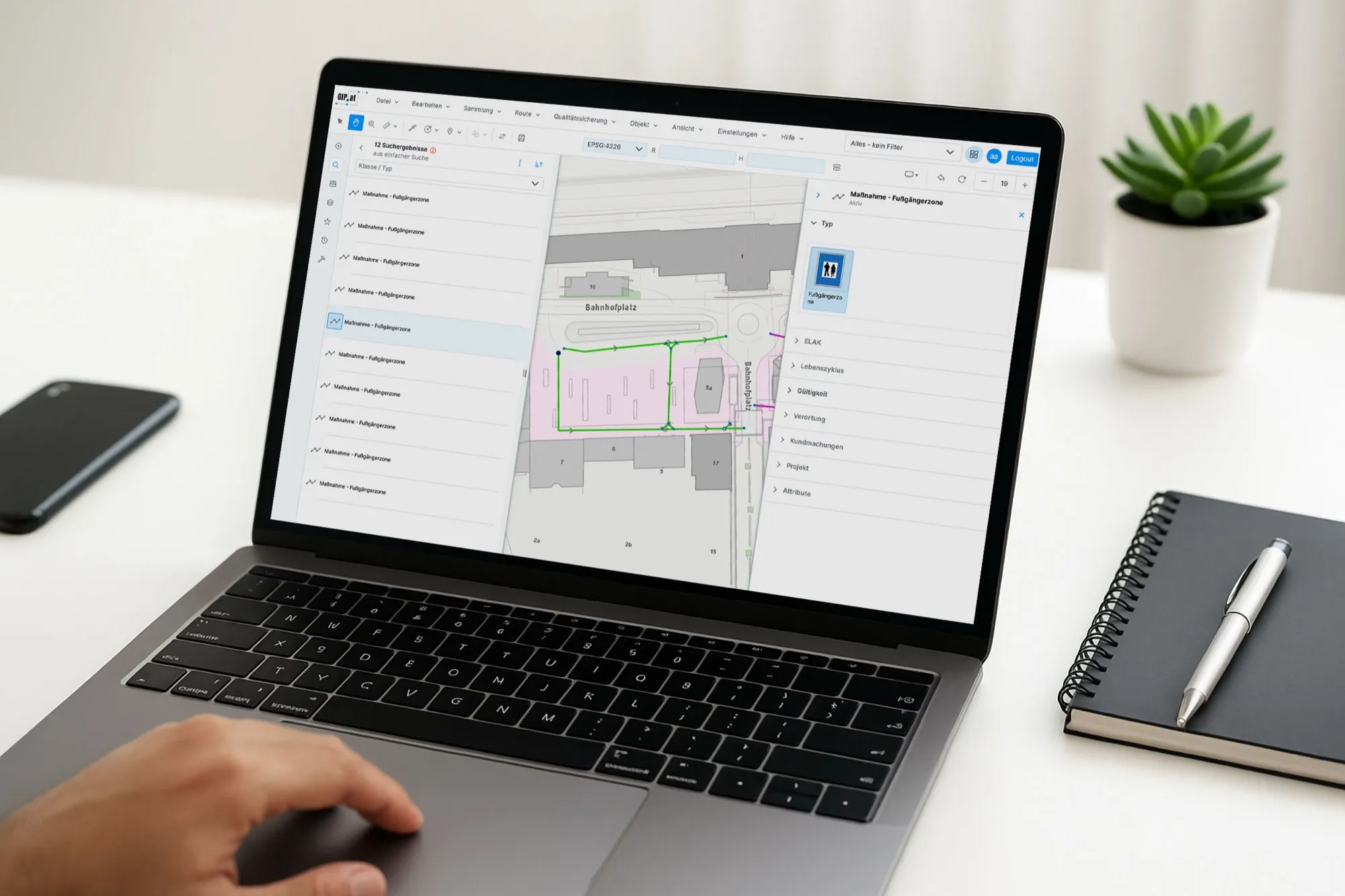
Through a map-based interface, users can spatially contextualise, search and query transport data. Features such as search and location-based information make data accessible exactly where it is relevant: in its concrete geographical context.

Individual parts of the client can also be embedded directly into the existing specialist applications of the GIP partners. GIP functionality is thus not confined to a single central application – it can be integrated into the very systems where it is needed in day-to-day work.
Metadata Drives the User Interface
A distinctive technical characteristic is the metadata-driven user interface.
The client receives not only specialist data from the server, but also information on how that data should be displayed and edited in the interface. On this basis, the application renders almost all of its controls dynamically.
New specialist content can therefore be incorporated far more flexibly. Not every change to the data model automatically requires a newly programmed interface. This eases ongoing development and reduces dependencies between domain-level changes and frontend development.
Performant, Standards-Based GIS Visualisation
The map rendering was also designed specifically for working with large volumes of geodata. OpenLayers and GeoServer provide performant, standards-based GIS visualisation. These components support common geodata standards and make it possible to display even large and complex datasets in a structured way on the map.
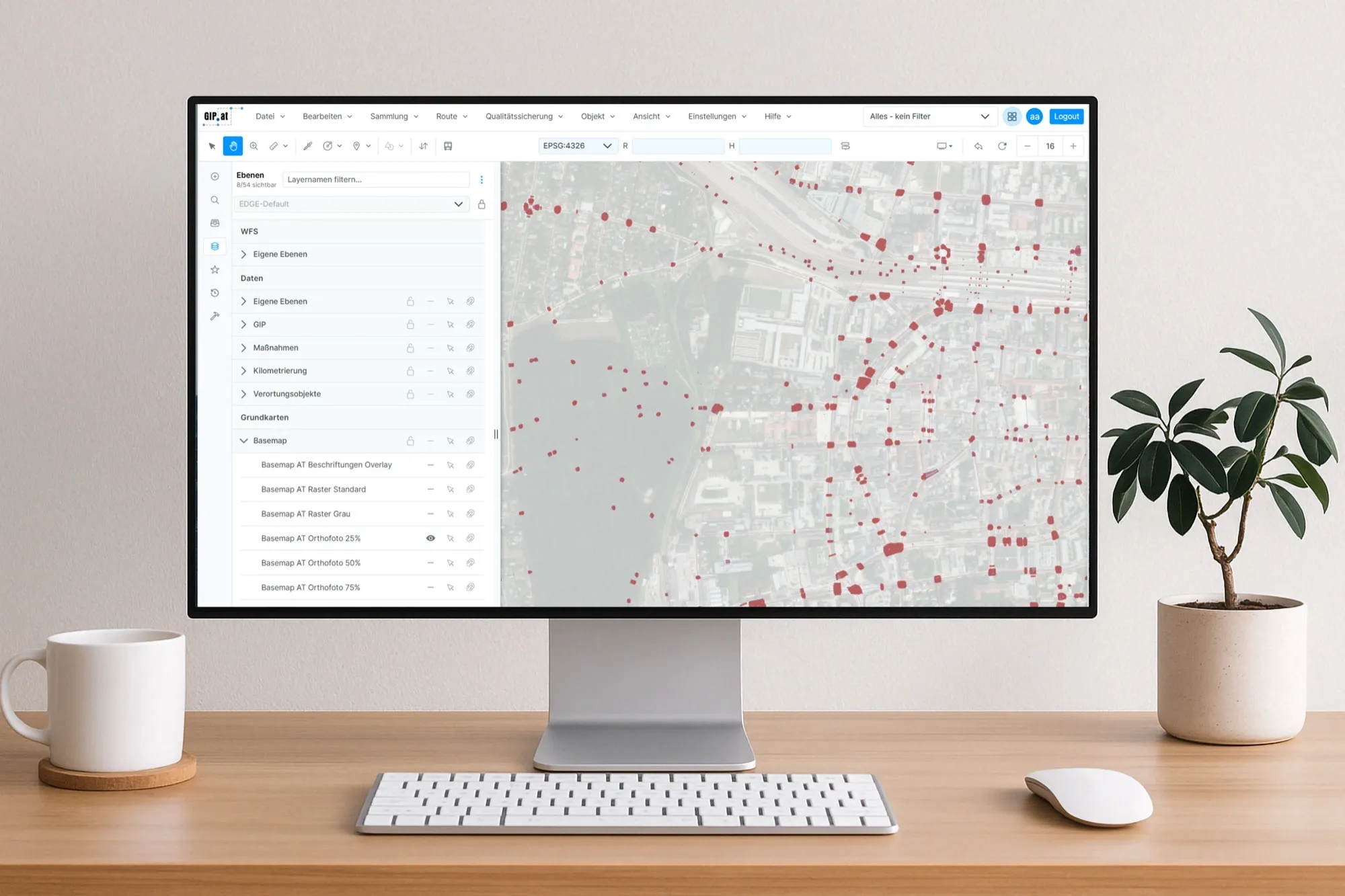
Central Sign-In and Consistent Permissions
Central authentication and permission management ensure that users can access – and modify – only the functions they need, depending on their role and organisation. Where appropriate, existing reference implementations such as the Austrian public administration’s PVP sign-in are integrated.
Results & Benefits: A Future-Proof Foundation for Austria’s Transport Data
As of July 2026, the project is in its final phase. The new client creates a foundation that will support the further development of the GIP for years to come.
The value lies above all in the modernisation of a central transport data infrastructure. A client that had grown organically over the years has become a modern web application that better reflects specialist complexity and makes large data volumes usable with high performance.
For ÖVDAT and the GIP partners, this means:
- More efficient day-to-day workflows when working with transport data
- Improved usability for different users and specialist ways of working
- Better performance, including fast map rendering even with large volumes of geodata
- Central data maintenance and access for all GIP partners
- Higher data quality and end-to-end traceability of edits
- Simpler collaboration between GIP partners through shared processes and a common technical foundation
- Flexible integration options for existing specialist applications
- A future-proof software platform with an open, extensible and maintainable architecture
Outlook: More Integration, New Assistants and Additional Interfaces
The GIP is continuously evolving. The new client was therefore never designed as a closed, standalone solution, but as a shared foundation for further functions and applications.
The roadmap includes additional assistants, interfaces and integrations into the GIP partners’ specialist applications. Future GIP applications can build on the components and concepts of the new client.
Specialist applications that have grown over many years can rarely be modernised through a purely technical relaunch. It takes a deep understanding of the specialist workflows, a clear architecture and the early involvement of the people who work with the system every day.
About ÖVDAT
ÖVDAT, the Austrian Institute for Transport Data Infrastructure (Österreichisches Institut für Verkehrsdateninfrastruktur), is an association that provides the organisational framework for operating the GIP across Austria. Since 2016, the operation, maintenance and continuous development of the Graph Integration Platform have been managed through the association.
More on "Mobility"

Mobility
Workforce Planning in Public Transport: From Excel Lists to a Fully Digitalised Process
How a municipal public transport operator plans tasks, teams and staffing requirements centrally and connects multiple specialist systems in a single platform.

Mobility
Predicting Road Surface Damage with AI: Evolit's Contribution to the EU Research Project ESRIUM
How Evolit uses machine learning in the EU research project ESRIUM to predict road surface damage and support motorway operators with predictive maintenance.

Mobility
Even Greater Rail Safety: ETCS Key Management Center for ÖBB Modernized
Evolit modernized an ETCS Key Management Center for ÖBB Infrastruktur AG that centrally manages secure key administration in railway operations.