


Julia Rinnhofer
Key Takeaways
- A public transport operator replaced the distributed, largely manual workforce planning in its construction and asset management with a central web-based integration platform.
- Planners coordinate tasks, teams and staffing requirements across departments following a shared process.
- Consistent terminology and structured data replace manual coordination and scattered Excel lists.
- Changes to planning data remain traceable — and the foundation for automated service billing is in place.
Every switch, every lift and every technical asset of a public transport operator has to be regularly inspected, serviced or maintained. The activities required for this, however, originate in different specialist systems — as does the shift planning and assignment of employees.
Planners at the transport operator had to establish the connection between them manually:
- Which tasks need to be done?
- When should they take place?
- Which team and which staffing requirements are scheduled for them?
Evolit developed a workforce planner for this transport operator: a web platform that brings this information together. It supports operational planning and hands the finished planning results over to the existing staff assignment system.
Starting Point & Challenge: Many Data Sources, No Shared Planning
Without a central planning platform, planners had to merge activities from various sources manually and determine when which tasks would be handled by which team. The result? Excel spreadsheets and countless local lists. On top of that came different ways of working in the individual departments. Even technical terms were not always defined consistently across systems or units.
This led to duplicated data maintenance, additional coordination effort and a fragmented data basis. Changes and earlier planning states could only be traced to a limited extent. Consistently structured data for automated service billing was also missing.
Off-the-shelf software was not an option for this task: the solution had to connect several existing systems while also reflecting the transport operator’s specific planning processes.
Analysis & Approach: Structuring Requirements, Unifying Terminology
The technical integration was only one part of the task. Just as important was mapping the different working practices of the departments involved into a shared domain model.
Together with the customer, Evolit analysed the existing planning processes and structured the requirements into concrete use cases. Open questions, variants and special cases were clarified in workshops with the specialist departments and IT operations. The results fed continuously into the further design and implementation — as did early feedback from future users, who tested typical workflows on clickable prototypes.
Another focus was on unifying terminology. Terms that were used differently across departments or systems were given unambiguous definitions and transferred into a shared data and process logic.
Implementation & Solution: A Central Hub Between the Specialist Systems
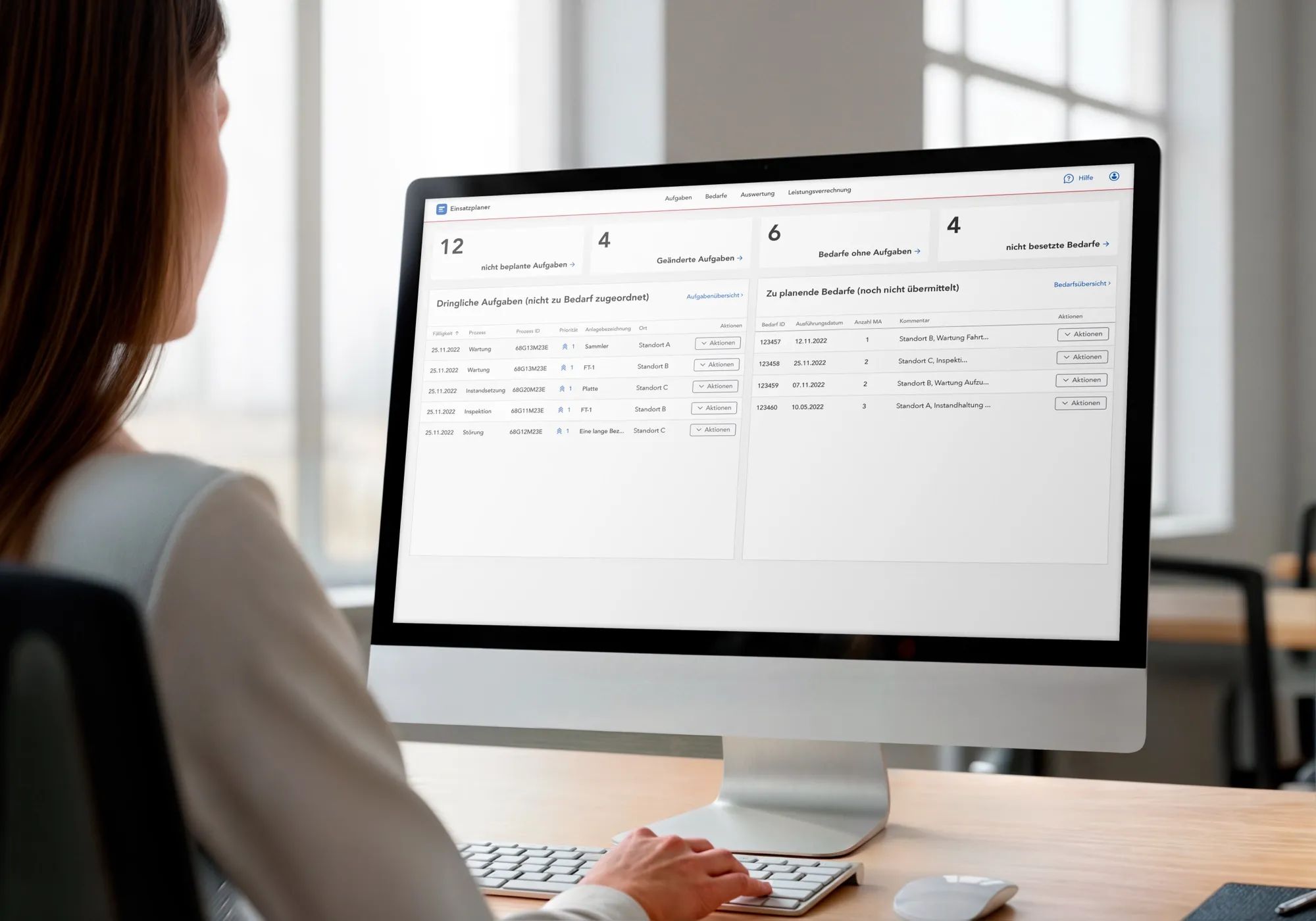
The web-based workforce planner connects all systems with each other: from the existing specialist systems and operational planning through to the existing staff assignment system.
Activities from different sources are brought together centrally. Planners can turn them into work tasks, set dates and assign teams and staffing requirements. The finished plan is then handed over to the existing staff assignment system, where the actual allocation of employees takes place.
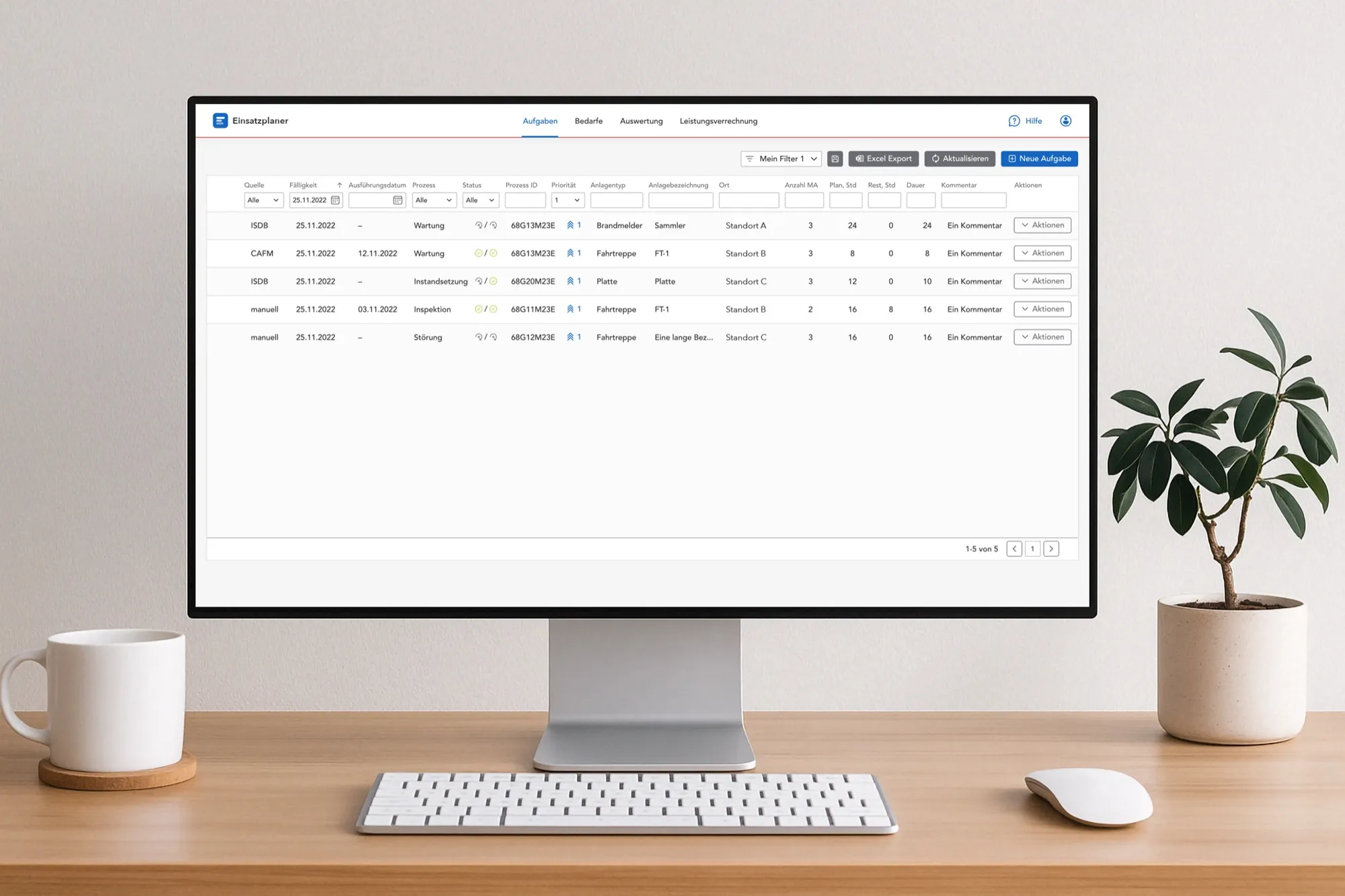
The platform does not replace the existing systems. It connects their information into an end-to-end planning process and feeds planning results back into the existing system landscape.
Since the solution is used in a sensitive infrastructure environment, information security, access rights and traceability were taken into account from the very beginning. Changes to planning data are also logged and historised.
Results & Benefits: Unified Planning Instead of Scattered Lists
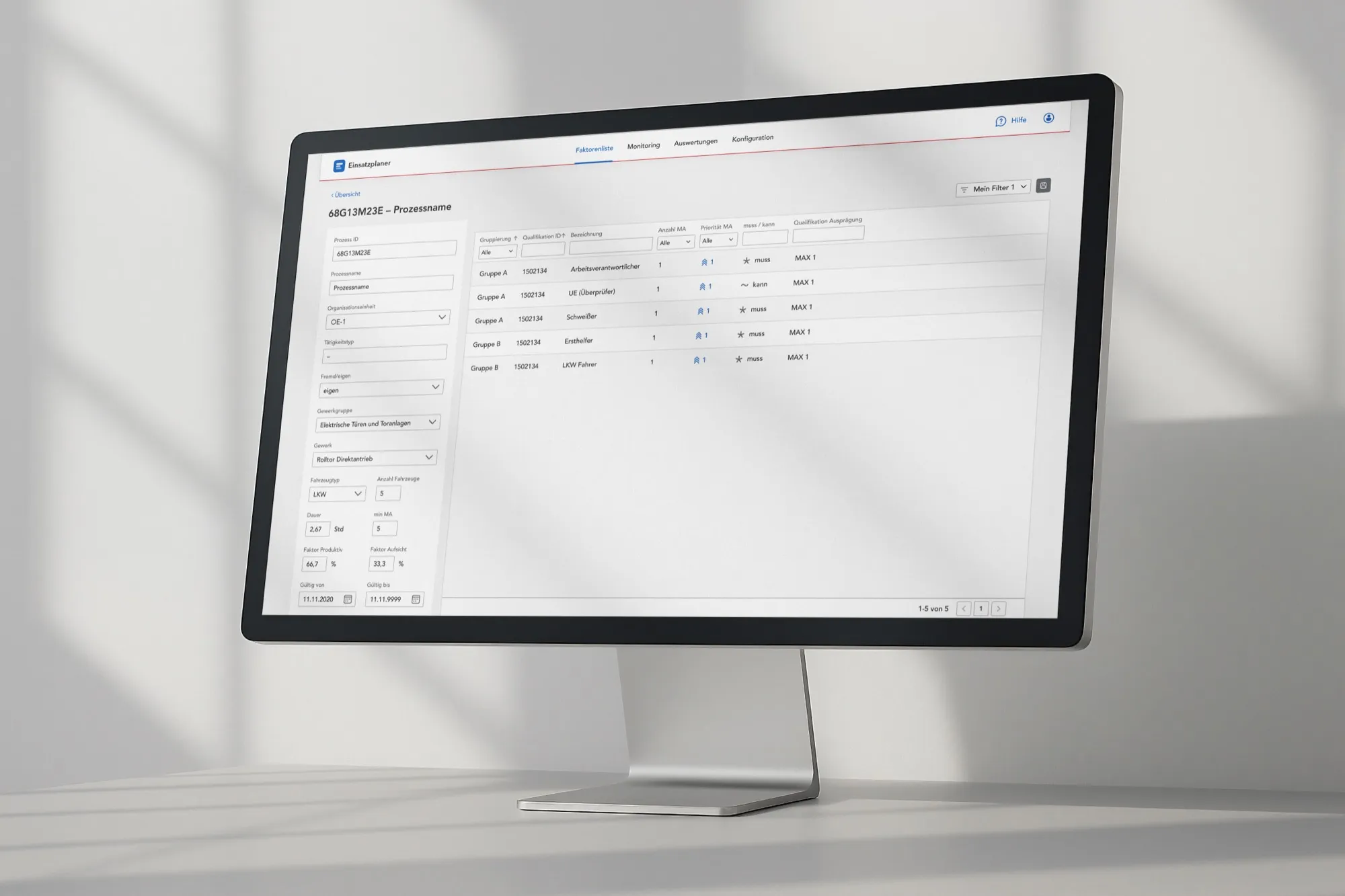
For the first time, the transport operator now has an overarching system for operational workforce planning in its construction and asset management.
Centralised planning
Activities from different specialist systems are brought together in one shared platform. Planners can see which tasks are due and which teams and staffing requirements are assigned to them. Manual parallel planning and local lists are reduced.
End-to-end data exchange
Planning information no longer has to be transferred between different applications multiple times. The workforce planner connects the upstream systems with the existing staff assignment.
Consistent processes and terminology
The individual departments plan according to a shared domain logic. Different definitions and ways of working were unified in one central model.
More transparency and traceability
Changes and earlier planning states are documented and historised. Decisions and processing steps remain traceable even in retrospect.
Foundation for automated service billing
The structured and historised planning data creates the basis for automatically allocating delivered services to the corresponding units or clients in the future.
Outlook: Configurable for New Processes and Requirements
Assets, responsibilities and workflows of public transport operators change continuously.
The workforce planner was therefore designed so that many domain settings can be changed through configuration. These include, among others:
- Data fields and input forms
- Validation rules
- Workflows
- Roles and permissions
- Parts of the user interface
As a result, many functional or organisational changes can be implemented without launching a dedicated development project for every adjustment.
This simplifies long-term maintenance and allows the platform to be adapted step by step to the operator’s new requirements.
More on "Mobility"

Mobility
GIP 2.0 for ÖVDAT: A New Web Client for Austria's Transport Graph
Commissioned by ÖVDAT, Evolit redeveloped the GIP 2.0 client as a modern web application – delivering simpler workflows, better usability and a maintainable long-term foundation for Austria's transport data.

Mobility
Predicting Road Surface Damage with AI: Evolit's Contribution to the EU Research Project ESRIUM
How Evolit uses machine learning in the EU research project ESRIUM to predict road surface damage and support motorway operators with predictive maintenance.

Mobility
Even Greater Rail Safety: ETCS Key Management Center for ÖBB Modernized
Evolit modernized an ETCS Key Management Center for ÖBB Infrastruktur AG that centrally manages secure key administration in railway operations.